
How to Use AI to Turn Customer Signals Into Better Marketing Decisions
Learn how to use AI to turn reviews, calls, customer questions, and CRM notes into sourced patterns, owned marketing decisions, and useful next actions.
Learn how to use AI for marketing by turning customer and market signals into decisions, useful work, business results, and learning.

An attorney can now examine patterns across their own reviews, competitors’ reviews, recorded calls, customer questions, and other market evidence at a scale that would have been difficult for a small team a few years ago.
That evidence can reveal what clients value, what they distrust, why they choose one firm over another, and how they describe their problem. It can shape audience profiles, positioning, website pages, videos, social content, and the next questions the firm investigates.
The opportunity in AI marketing is larger than producing content faster. A business can understand more, see important changes earlier, test useful responses sooner, and learn from the result.
Access to AI does not create that advantage by itself. The business needs a growth system that turns raw signals into usable knowledge, decisions, marketing work, business results, and learning.
Marketing Engine is StackEngine’s approach to building and operating that growth system.
Businesses have always wanted to understand their customers, evaluate competitors, test messages, create useful content, and improve results. The difference is how much information can now be examined and how quickly it can become useful.
A small business may have years of reviews but no practical way to study them beyond reading a few at a time. Sales and support calls may contain repeated objections, questions, and customer language, but listening to every recording and organizing the patterns requires time the team does not have.
Competitor websites, reviews, videos, search results, social conversations, and advertising provide more evidence. Until recently, making sense of all of it could require a research team, specialist software, or weeks of manual work.
AI changes those limits.
It can help a business:
The point is not that AI already knows the right answer. It does not understand the business’s priorities, customers, risk, or taste without help. Its output still needs evidence, context, and human judgment.
The point is that work once ruled out by time, cost, staffing, or access to information may now be worth considering.
That should change the first question a business asks. Instead of starting with, “Which AI tool should we buy?” it can start with, “What could we understand or accomplish now that was not practical before?”
AI marketing often begins with data the business already has.
Other signals come from changes outside the business: a new capability, a competitor’s move, a shift in customer behavior, a question appearing across several conversations, or a result that no longer matches what used to work.
In many businesses, none of this material is completely absent. It is distributed across platforms, departments, documents, dashboards, and people’s memories.
AI can make that evidence easier to examine, but a summary is not the same as understanding. The source still matters. A repeated pattern is different from one striking comment. An inference is different from a verified fact. An interesting observation is different from a reason to act.
A signal becomes valuable when it can change a decision.
That is the shortcoming of using AI only as a collection of task tools. One tool analyzes reviews. Another writes copy. Another generates images. Each may work well, but the research can still end as a report and the content can still be created without the decision that should connect them.
The missing piece is not another output. It is the system that turns what the market is saying into growth work the business can use.
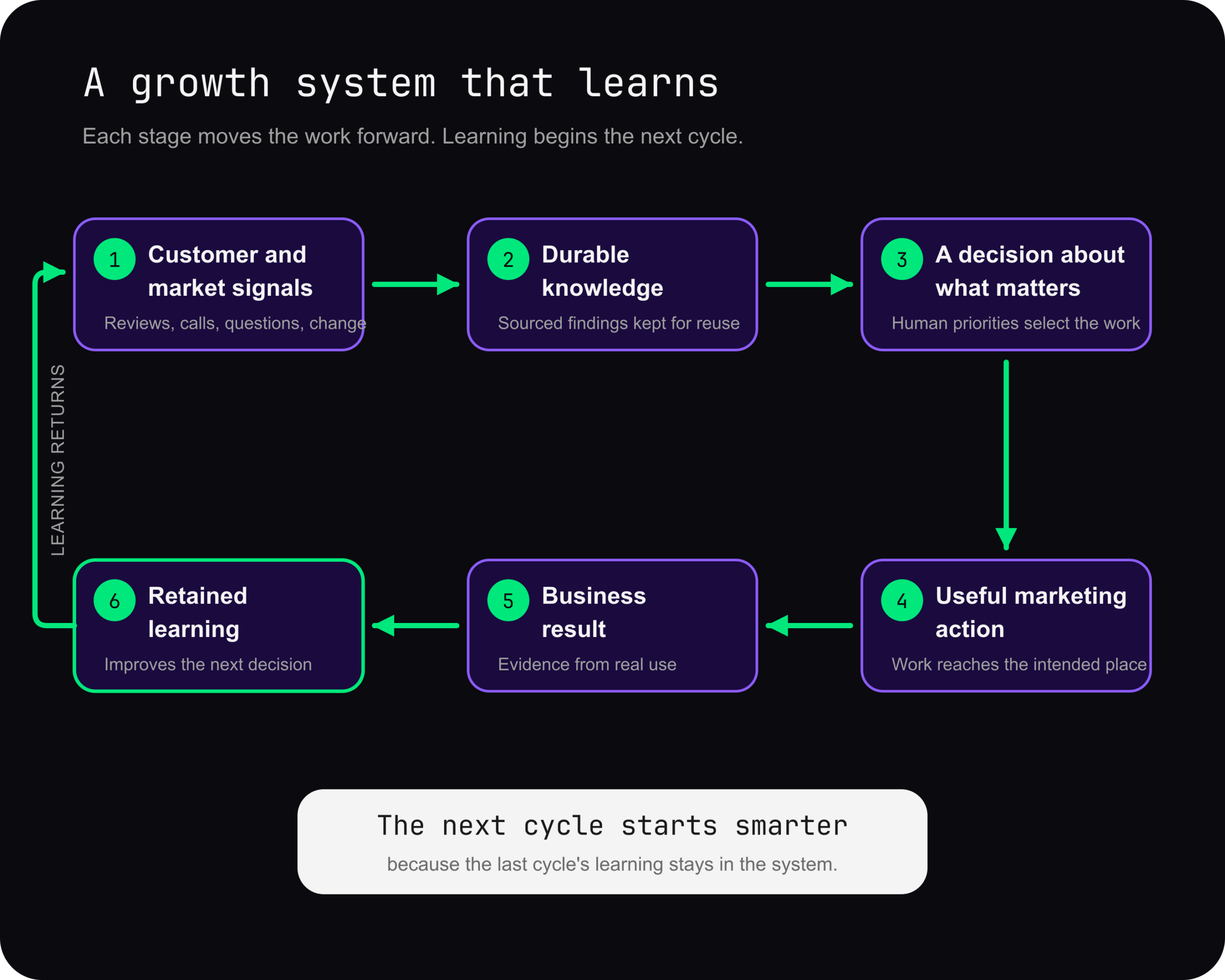
A growth system repeatedly turns customer and market signals into usable knowledge, a decision, useful action, a business result, and learning that improves the next cycle.
The basic loop is simple: customer and market signals become durable marketing knowledge, a decision about what matters, useful marketing action, a business result, and learning that improves the next decision.
Seeing a customer pain earlier can matter because the business has more time to respond. Recognizing winning language can improve how the company explains an offer. Understanding why competitors receive negative reviews can reveal an expectation the business should address in its service, positioning, or content.
The response may be:
Speed matters, but activity is not the goal. Shipping more content earlier is not useful if the work is poorly chosen or nobody learns from the result.
The advantage comes from moving through the complete loop. The business sees something meaningful, decides what it means, responds in a useful way, observes what happens, and retains what the next decision should know.
Growth also needs a defined meaning. For one business it may mean qualified inquiries and pipeline. For another it may mean conversions, retention, useful attention, trust, product engagement, or a better decision about where not to invest.
The system should be accountable to the result the business selected, not merely the volume of research, content, messages, or automation it produced.
Every founder or marketing leader should be able to answer a practical question: who is responsible for building and improving this growth system?
Marketing Engine is the name I use for the connected system that turns business knowledge and market evidence into decisions, useful marketing work, results, and retained learning.
It combines human judgment with AI, agents, data, code, tools, and repeatable workflows. Its value does not come from any one component. It comes from how the components share context, perform defined jobs, hand work forward, and improve from what happens.
Marketing Engine is not one application. It does not require one model, database, automation platform, or interface. Those choices can change as technology improves and as the business’s needs change.
The more durable parts belong to the business: its identity, offers, audience understanding, customer evidence, decisions, working methods, results, and corrections.
Human direction also remains part of the system. AI can examine more information and perform more of the work, but people still determine business purpose, priorities, positioning, taste, risk, and consequential approval.
Marketing Engine can be broad without requiring a business to build everything at once. It can begin with one complete loop around one useful need, then expand when another capability or connection makes the result better.
A growth system produces more than content. It should create useful outputs at several levels.
The system can produce customer and market intelligence, audience profiles, customer-language findings, competitor patterns, opportunity assessments, prioritized decisions, experiment plans, content concepts, and execution briefs.
These outputs help the business decide what to do. They are not valuable merely because they exist in a report or database.
The decision may lead to a website page, article, video, social post, advertisement, email, sales resource, outreach sequence, presentation, campaign, or another form of work appropriate to the business and channel.
The system should also define where the work goes, who approves it, and what result it is intended to influence. A completed draft sitting in a folder is an output, but it has not yet produced a marketing result.
Marketing work may be intended to create qualified attention, stronger customer conversations, better positioning, inquiries, leads, pipeline, conversion, retention, or another selected outcome.
The system can produce the work and the experiment. It cannot guarantee the result. That is why measurement and interpretation belong inside the loop.
The final output is what the next cycle knows.
Which customer language earned a response? Which assumption proved wrong? Which channel fit the audience? Which objection kept appearing? Which work should continue, change, or stop?
When those answers return to the system, the business does not have to begin every marketing decision from zero.
| Layer | Examples | What happens next |
|---|---|---|
| Understanding | Review patterns, audience profiles, market findings | Supports a decision |
| Decisions | Selected opportunities, priorities, plans, briefs | Directs the work |
| Marketing work | Pages, articles, videos, campaigns, outreach | Reaches the intended audience |
| Business results | Inquiries, pipeline, conversion, retention, trust | Provides evidence |
| Learning | Winning language, corrections, changed assumptions | Improves the next cycle |
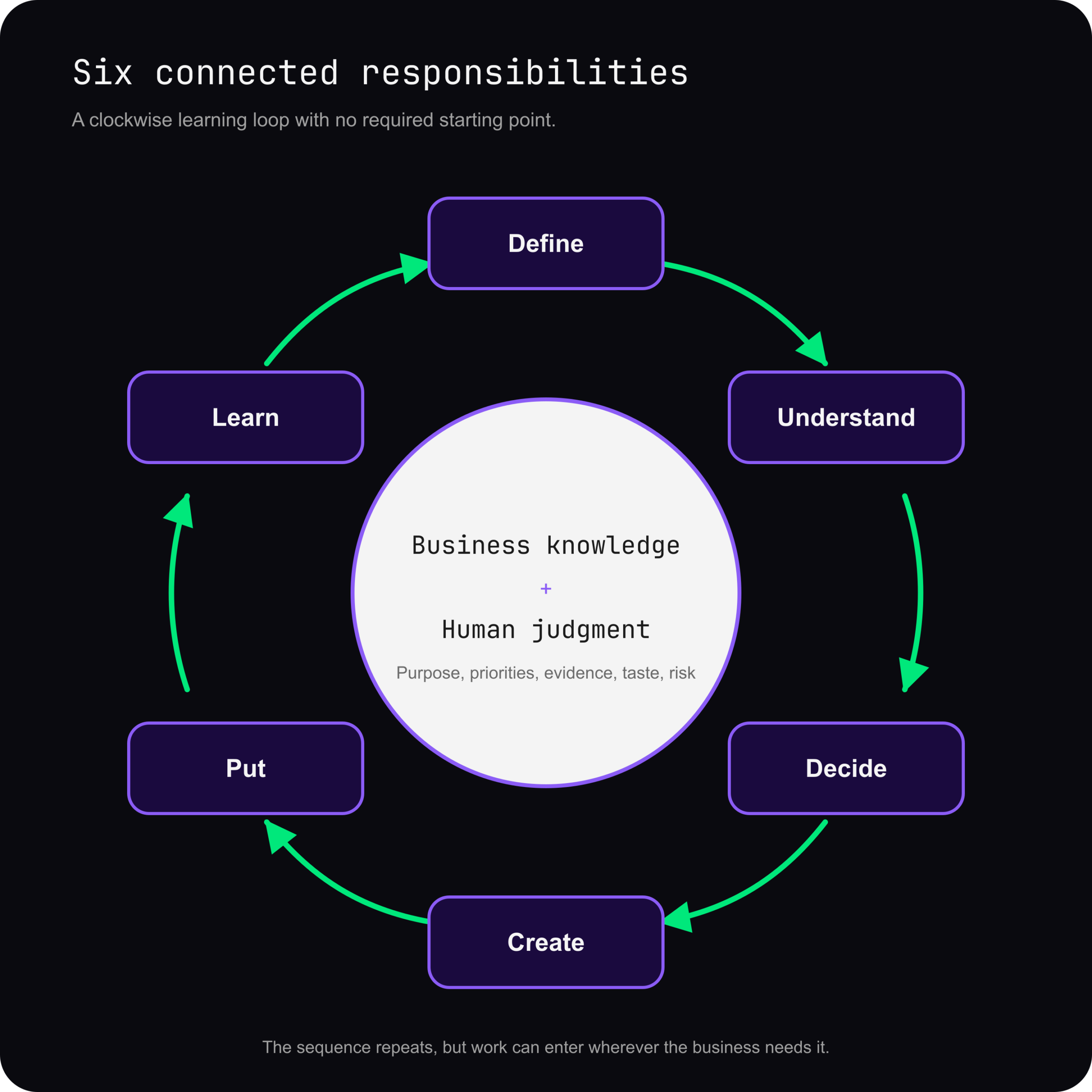
I organize Marketing Engine around six connected responsibilities. They describe the jobs the system must be able to perform, not six required departments or six agents.
Clarify what the business stands for, what it offers, who it wants to reach, and what it can credibly promise. Brand direction, audience understanding, positioning, proof, voice, and visual identity give later work a foundation.
Learn what customers need, how they describe their situation, what competitors are doing, and what is changing in the market. Research should preserve sources and uncertainty, then produce something another part of the system can use.
Choose which opportunities, experiments, and marketing work deserve attention. A signal is not automatically an idea. An idea is not selected work. A research report is not a decision.
Turn the decision into useful work. The system gives writers, designers, agents, and other creators the business context, audience, evidence, objective, and instructions required for the job.
Move the approved work into the place where it can produce a result. Publishing an article, distributing a video, updating a website, launching an experiment, and handing a resource to sales are different from creating the asset.
Observe what happened, decide what the result means, and carry useful corrections forward. Learning may change the message, audience, channel, workflow, or decision to continue.
These responsibilities can interact in different orders. A job may begin with a customer question, a business need, a market change, a creative idea, or a disappointing result.
The connections matter more than the sequence. Define gives later work a clear picture of the business. Understand gives Decide evidence rather than guesses. Decide gives Create a selected job. Create gives Put approved work with a purpose. Put gives Learn a real result to examine.
Learn can then change any part of the system.
Consider an attorney who wants to improve the firm’s marketing. This is an illustrative scenario, not a client case or a claim about guaranteed results.
The firm begins with evidence it already has: reviews, recorded calls it is permitted to use, CRM notes, customer questions, website behavior, and the language people use during consultations.
It also examines competitors’ reviews. Positive reviews show what clients value across the market. Negative reviews reveal frustrations, missed expectations, communication problems, and places where firms fail to earn trust.
AI can help organize the evidence and surface recurring patterns. A person still reviews the sources, decides which patterns matter, and separates a genuine market signal from an isolated complaint.
The firm may learn that prospective clients are less concerned about abstract legal credentials than about response time, clear explanations, cost uncertainty, and knowing what happens next. That finding can improve the audience profile and the way the firm positions its service.
The business then chooses one opportunity. Perhaps people repeatedly ask what to expect during the first week after hiring an attorney.
Purpose-built does not mean manipulative. The firm can use the same decision in several ways:
After the work is approved and distributed, the firm observes what happens. Do people find the guide? Do prospective clients arrive with better questions? Does the resource help consultations? Do new reviews mention the clarity or response time the firm tried to improve?
The answers return to the system. The firm keeps useful language, corrects weak assumptions, and decides what the next cycle should investigate or create.
That is more than using AI to write legal content. It is a growth system that learns from the market and from its own work.
The complete Marketing Engine covers a broad range of marketing work. A business does not need to build the entire system before it can benefit.
Start with one valuable, recurring need.
It might be understanding why qualified prospects do not respond, improving website messaging, turning customer questions into useful content, finding a better way to plan videos, or learning which objections are slowing sales.
Then build the smallest complete loop around it:
The first loop does not need to represent the whole future system. It needs to do one real job well enough that the business can learn from it.
As more loops prove useful, they can share the same business knowledge, evidence, decisions, approval boundaries, and learning. That is how separate AI capabilities and marketing activities become a growth system.
AI has changed what businesses can understand and accomplish in marketing. The larger opportunity is not another tool or a higher volume of content. It is building the system that turns new capability into useful work, business results, and learning that compounds.
Marketing Engine is how I am putting that idea into practice.
If you want to explore what AI could help your marketing understand or accomplish, start with one real business need. If it would help to think it through together, start a conversation with StackEngine.
In This Guide
Learn how to use AI to turn reviews, calls, customer questions, and CRM notes into sourced patterns, owned marketing decisions, and useful next actions.

Learn how to start building an AI marketing system by choosing one real marketing job, completing its context-to-learning loop, and automating only after the work is understood.